Business
Why Most Small Businesses Stay Invisible Online Despite Having a Website
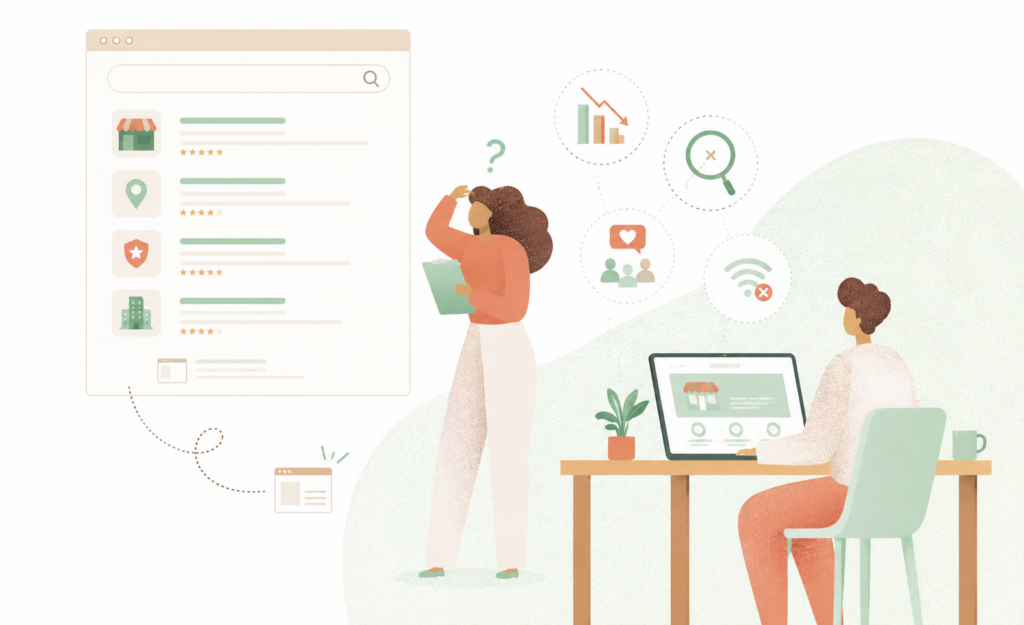
You paid a developer. You have a domain name. There is a homepage, an About Us page, and a contact form that occasionally pings your inbox. By every conventional measure, your business is online. So why is your phone not ringing?
This is one of the most quietly frustrating experiences in Indian small business today. Thousands of shopkeepers, service providers, clinics, coaching centres, and local brands invest in a website and then wait — and wait — for customers who never come. The website sits like a brochure locked inside a drawer that nobody can find.
The truth is hard but simple:
A website alone is not a digital presence. It is merely a starting point. And for most small businesses in India, the journey ends right there.
This blog breaks down exactly why that happens — and more importantly, what you can do today to fix it, largely for free.
1. Google Does Not Trust a Website It Cannot Verify
Search engines — and Google in particular — rank businesses based on a combination of relevance, authority, and trust. A brand-new website with no external signals is, in Google’s eyes, an unverified entity. It could belong to a thriving business or to someone who registered a domain and disappeared. Google does not know. And until it does, it will not rank you.
One of the fastest ways to build that trust is through consistent presence on third-party platforms — particularly local business listing websites and business directory websites that Google already trusts. When your business name, address, and phone number (NAP) appear consistently across multiple credible platforms, Google reads it as a signal of legitimacy.
Think of it this way: Google is not just reading your website. It is reading the entire internet for mentions of your business. Every listing is a vote of confidence.
2. The Website Is the Destination — But Nobody Has the Address
Consider how your potential customers actually search. A person in Jaipur looking for a plumber does not type your web address into their browser. They type “plumber near me” or “plumber in Vaishali Nagar” into Google. What comes up in those results is determined not just by your website, but by your visibility across the broader local search ecosystem.
That ecosystem includes:
- Google Business Profile (formerly Google My Business)
- Local business listing websites like Justdial, Sulekha, and IndiaMART
- Free business listing platforms and niche business directory websites
- Social media pages and review platforms like Google Maps and Facebook
Without being present on these platforms, your website is technically live but effectively invisible — like having a shop in an alley with no signboard, no map pin, and no one to direct people there.
3. The Five Reasons Your Website Is Not Generating Business
Reason 1: No Google Business Profile
Google Business Profile is the single most important free tool for local businesses in India and yet a staggering number of small businesses have either not claimed their profile or have left it incomplete. When someone searches for your business category in your city, Google displays a “Local Pack” — a map with three business listings. If you are not on Google Business Profile, you do not exist in that pack. Full stop.
Reason 2: Not Listed on Any Business Directory Website
Business directory websites are the digital equivalent of the Yellow Pages — except they are actively crawled by search engines and used by millions of Indians every day. Platforms like Justdial, Sulekha, TradeIndia, and IndiaMart are high-authority domains. When your business appears on them with accurate information, you gain both direct traffic from platform users and indirect SEO benefit as Google sees these trusted sites referencing your business.
Reason 3: Inconsistent or Missing NAP Data
NAP stands for Name, Address, and Phone Number. Google cross-references your NAP data across dozens of local business listing websites to verify that your business is real and to understand exactly where you are located. If your shop is listed as “Sharma Electronics” on one platform and “Sharma Electronics & Accessories” on another, with a different phone number on a third — Google gets confused, and confused search engines do not rank businesses confidently.
Reason 4: Zero Customer Reviews Online
Reviews are currency in the attention economy. A business with 47 four-star reviews on Google will almost always outrank a competitor with a more polished website but zero reviews. Indian consumers read reviews before calling, before visiting, and certainly before buying. If your business profile has no reviews, it signals either that you are new, that customers are indifferent, or — in the worst interpretation — that you are not actually operating.
Reason 5: The Website Itself Is Not SEO-Ready
Many small business websites in India are built as digital visiting cards — attractive to the eye but invisible to search engines. No meta titles, no keyword-relevant content, no local signals (city or area name in the page text), slow loading speed on mobile, and no structured data. Google needs these signals to understand what your business is, where it operates, and whom it serves.
Also read:- How to Get a Free Business Listing That Actually Drives Customers
4. The Free Business Listing Strategy That Actually Works
Here is the good news: building a strong local digital presence does not require a large budget. The most impactful platforms for Indian small businesses are either free or offer highly effective free tiers. What they require is time, consistency, and attention to accuracy.
The essential free business listing checklist for Indian businesses:
| Platform | Why It Matters | Cost |
|---|---|---|
| Google Business Profile | Appears in Google Maps & Local Pack searches | Free |
| Justdial | High-traffic platform with strong local search in India | Free (basic) |
| Sulekha | Popular for services — plumbers, tutors, caterers, etc. | Free (basic) |
| IndiaMART | Essential for B2B and product-based businesses | Free (basic) |
| Facebook Business Page | Social proof + indexed by Google | Free |
| Bing Places | Underutilised but valuable for broader reach | Free |
| TradeIndia | Strong for manufacturing and wholesale businesses | Free (basic) |
| Yellow Pages India | Legacy but still crawled by search engines | Free |
The rule of thumb: aim to be consistently listed on at least 10 to 15 reputable local business listing websites with identical NAP data. This alone can dramatically improve how Google perceives and ranks your business in local searches.
5. What ‘Consistent’ Really Means — and Why It Is Harder Than It Sounds
Consistency in local SEO is not just about having the same phone number. It means your business name is written identically across every platform. It means your address uses the same format — flat number, building name, street, area, city, pincode — every single time. It means your business category is accurate and matching. It means your website URL is the same everywhere.
Common inconsistencies that sabotage Indian small businesses:
- Using a mobile number on the website but a landline on Justdial
- Business name spelled differently — “S.K. Traders” vs “SK Traders” vs “S K Traders”
- Old address still live on directories after a shop shift
- Website URL missing from business directory profiles
- Mismatched pin codes — a single wrong digit confuses Google’s geolocation
Audit every listing at least once every six months. It is not glamorous work, but it is foundational.
6. The Indian Consumer Journey Is Hyper-Local — Your Strategy Must Match
India’s digital growth story is predominantly a mobile and hyperlocal one. According to multiple industry reports, searches with “near me” intent have grown exponentially in India over the last five years, driven almost entirely by smartphone users in tier-1 and tier-2 cities looking for services, shops, and food within a few kilometres of their location.
This is the customer who will ring your doorbell — but only if they can find you. They are not browsing your website directly. They are searching on Google Maps, asking Justdial, or checking a local business listing website for the top-rated electrician or bakery or coaching class in their neighbourhood.
A beautiful website with no local listings is like a well-lit shop in a city your customers are not visiting. The battle for the Indian consumer is fought and won on local search — and local search lives on directories, maps, and review platforms, not just websites.
7. Content Is Still King — But Only If It Speaks the Right Language
Many small business websites in India are either content-sparse (just a logo and a phone number) or written in the style of a corporate annual report. Neither helps. Google rewards websites that answer the questions real customers are actually typing into search bars.
What your website content should answer:
- What exactly do you sell or offer? (Be specific — not just “services” but “AC repair services in Malviya Nagar, Jaipur”)
- Where are you located? (Include area, city, nearby landmark)
- What makes you different from the shop next door?
- What are your working hours and how does someone reach you?
- Do you have a blog or FAQ that addresses common customer questions?
Adding even one locally-relevant blog post a month can meaningfully improve how often Google surfaces your website in relevant local searches over time.
8. An Actionable Checklist to Start Today
You do not need a marketing agency or a large budget to take these steps. Most can be done in a weekend:
- Claim and fully complete your Google Business Profile — add photos, hours, description, and primary category
- Submit a free business listing on Justdial, Sulekha, IndiaMART, and TradeIndia
- Verify that your NAP data is absolutely identical across all platforms
- Create or update a Facebook Business Page with your website link and business hours
- Ask your five most satisfied customers for a Google review — politely and personally
- Update your website’s homepage title and description to include your city or area name
- Add your business to Bing Places for Business — it takes ten minutes and is completely free
- Set a calendar reminder to audit all your listings every six months
Visibility Is Not an Accident. It Is a System.
The businesses that dominate local search in India did not get there by accident. They claimed their Google Business Profile. They registered on every relevant local business listing website. They ensured their NAP data was airtight. They asked for reviews. They wrote content that spoke to their customers’ actual searches. And they did it consistently — month after month.
None of it is complicated. All of it is available for free. What it requires is the understanding that a website is a foundation, not a finish line.
Your customers are searching. The only question is whether they will find you — or your competitor.




Categories
Latest Posts
Top Free Business Listing Sites in India to Boost Your Online Presence (2026)
Business
May 18, 2026

Free Business Listing vs Paid Ads — Which Works Better for Indian Businesses?
Business
Apr 21, 2026
How to Get a Free Business Listing That Actually Drives Customers
Business
Apr 10, 2026

Why Free Business Listing Sites Fail for Many Businesses
Business
Mar 26, 2026


